|
Document shared with you: ‘शबे बरात की फजीलत और सब कुछ इसके बारे में’





ख्वाजा मोइनुद्दीन चिश्ती की दरगाह का निर्माण कब हुआ
अजमेर में ख्वाजा मोइनुद्दीन चिश्ती की दरगाह या दरगाह का निर्माण 1236 में हुआ था, जब सुल्तान इल्तुतमिश ने ख्वाजा साहब की कब्र पर एक मकबरा बनवाया था। लेकिन, ये दरगाह बार-बार विस्तार और संरचित की गई है।
ख्वाजा मोइनुद्दीन चिश्ती का इंतेकाल 1236 में हुआ था, और उनकी क़ब्र पर एक सदा सा मकबरा बनाया गया था। बाद में, सुल्तान इल्तुतमिश ने 1236 में ही एक नया मकबरा बनवाया, जो आज भी दरगाह के रूप में मौजुद है।
बाद में, मुगल शाहों ने, खासकर अकबर ने, 1579 में दरगाह का विस्तार किया और उसमें कुछ नये महल और मस्जिद बनवाये। और, 1810 में, सिंधिया परिवार ने दरगाह का नया विस्तार किया और उसमें कुछ नये महल और मंडप बनवाये।
आजकल, अजमेर शरीफ दरगाह एक महत्वपूर्ण तीर्थ स्थल है, जहां हर साल लाखो लोग जियारत करने के लिए आते हैं।
Calling people towards Islam
Calling people towards Islam, every Muslim has an obligation.
Let the world embrace the whole world with the eyes of Islam.
Let us bring Islam to all human beings, by using our best quality and expertise.
Make peace in the world.
QURBANI | Slaughtering Animal on Eid Adhha
Ahekame Adha | Slaughtering Animal on Eid Adhha
INDIAN RAILWAY TELEPHONE ISLAM FOR ALL WORLD MUSLIM SHAADI MUSLIM NAMES
The Ahkam of Qurbani (Adha) with Arabic Dua
Mufti Ahmadul Qaderi MisbahiFounder of Darul Uloom Azizia, Dallas, TX
Translated by:
Omair Abdul Jabbar Qaderi, Student of Darul Uloom Azizia
The Qurbani is the sunnat of Sayeduna Ibrahim (Alaihis Salaam). Muslims were told to do Qurbani, Allah Tabaraka wa Ta’la says:

Therefore offer prayer for your Lord, and do the sacrifice. (Quran 110:2)
He (Swall Allahu alaihi wasallam) said, “This is the Sunnat of your father Ibraheem (Alahis Salaam).”
Sahaba said, “Ya Rasool Allah, what sawaab will we get in this?”
He (Swallal Allahu alaihi wasallam) said, “A virtue for every hair (on the animal).”
(Ahmad, Ibnu Majah)
Hadith 2: Sayedatuna Aisha (Radi Allahu anhu) narrates that Rasool Allah said, “There is no dearer deed of Ibne Adam in the days of Qurbani than flowing the blood (doing Qurbani) and that animal will come with his horns, hairs, and hooves on the day of Qayamt. Thee blood of the Qurbani reaches the stage of acceptance before it reaches the floor. (Tirmizi, Ibnu Majah)
Hadith 3: Sayeduna Abu Hurairah (Radi Allahu anhu) narrates the Beloved Prophet (Swall Allahu alaihi wasallam) said, “Whoever has the means and does not do Qurbani should not come near our place of Eid. (Ibnu Majah)
Hadith 4: Sayeduna Ibn Abbas (Radi Allahu anhu) narrates that the Beloved Prophet (Swall Allahu alaihi wasallam) said, “The wealth which is spent on Qurbani on the day of Eid, there is no dearer wealth than it. (Tabrani)
Hadith 5: Imam Ahmad (Radi Allahu anhu) narrates that the Beloved Prophet (Swall Allahu alaihi wasallam) said, “The best Qurbani is the one which expensive in price and very fat. (Imam Ahmad)
Hadith 6: Sayeduna Ali (Karam Allahu wajahaul kareem) narrates that the Beloved Prophet (Swall Allahu alaihi wasallam) said, “Four animals are not proper for Qurbani:
1) One eyed whose one eyedness is evident
2) Ill whose illness is visible
3) Crippled whose crippled ness is visible
4) Thin whose bones don’t have marrow
(Imam Ahmad, Tirmizi, Abu Dawood, Nasaee, Ibnu Majah, Darmi)
Hadith 7: Sayeduna Ali (Karam Allahu wajahaul kareem) narrates that, “Rasool Allahu (Swall Allahu alaihi wasallam) stopped us from Qurbani of [an animal whose] ears are cut and horns are broken. (Imam Ahmad, Ibnu Majah)
Hadith 8: Sayeduna Abdullah Ibn Masood (Radi Allahu anhu) narrates that the Beloved Prophet (Swall Allahu alaihi wasallam) said, “In Qurbani, a cow is from seven and a camel is from seven.” (Tabrani)
Hadith 9: Sayeduna Ibn Abbas (Radi Allahu anhu) narrates that the Beloved Prophet (Swall Allahu alaihi wasallam) said, “Rasool Allah (Swall Allahu alaihi wasallam) stopped us from Qurbani in the night.”
Hadith 10: Sayedatuna Ume Salma (Radi Allahu anha) narrates that the Beloved Prophet (Swall Allahu alaihi wasallam) said, “When you see the moon of Zul Hijjah and any one of you wants to do Qurbani, he should stop from shaving or cutting his hair and trimming his nails. (Muslim)
Hadith 11: Sayeduna Abdullah Ibn Umar (Radi Allahu anhu) narrates that the Beloved Prophet (Swall Allahu alaihi wasallam) said, “I have been ordered for the Yaumul Adha (The Day of Adha), Allah has made this day an Eid for the ummat.
A man asked, “Ya Rasool Allah, tell me if I have no animal besides a maneeha, so can I do Qurbani with it?
He said, “No, but cut your hair, nails, and mustache and shave the hair below the navel, in this your Qurbani will be fulfilled near Allah.” (Abu Dawood, Nisaee)
That is, whoever does not have the means to do Qurbani will get the reward for Qurbani by doing these things.
A) Owns 52 ½ taula of silver (612.4 grams, 19.75 ounces) or 7 ½ taula of gold
(87.48 grams, 2.82 ounces)
B) Or owns the equivalent of the price of these in business possessions or non-business possessions
C) Or owns equivalent of naqd [cash] or money
And the owned possessions are more than the hajate asalia [explaned in Masala 2].
Masala 2: Hajate asalia, that is, the things which are necessary to for a livelihood. Possessions of these things does not make Qurbani nor Zakat wajib. Like the house to live in, the clothes to wear in the summer and winter, possessions the household, animals or cars for transportation, equipment for work, and books for the people of knowledge.
Masala 3: By books it is meant the Quran, Hadith, Usool of Hadith, Usool of Fiqh, Ilm Kalaam, Akhlaq, and other religious books. Just like this, books of medicine are hajate asalia for a doctor.
Masala 4: Besides this, more than copy of books such as religious books, Nahw, Sarf, Nujoom, Stories, Deewan, and other books are not hajate asalia. If their value reaches nisab then Qurbani is wajib.
Masala 5: Quran Majeed is not hajate asalia for a Hafiz.
Masala 6: Qurbani is not wajib on a musafir (traveler) even if he is wealthy. Although, if he wishes to do Qurbani for Nafl reward then he may do so.
Masala 7: If a woman has jewelry given to her by her father or any other possessions which she owns which reaches the value of nisab then Qurbani is wajib on her also. This is the order of every year.
Masala 8: If a Malikun Nisaab (owner of Nisaab) does Qurbani in his name at one time and if he is a malikun nisaab the next year then it is wajib on him to do Qurbani [for that year]. This is the order of every year. (Tirmizi)
Masala 9: If malikun nisaab person does Qurbani in someone else’s name besides himself and not in his name then he is a grave sinner. So, if one wants to Qurbani for someone else then he should make arrangements for another Qurbani for the other person.
Masala 11: A camel must of 5 years, a cow and buffalo of 2 years, a goat, sheep, and ram of 1 year. If the animal is younger than this then qurbani is not permissible, if older than this then it is permissible, in fact it is better. However, if the six-month old offspring of sheep or ram is so big that from looking from afar the sheep or ram looks like a year old then it is permissible.
Masala 12: It is wajib for a sahibun nisaab to slaughter one goat or to slaughter a seventh of camel, cow, and buffalo, it is not permissible to slaughter less than one seventh of the animal.
Masala 13: To slaughter more than a seventh is permissible such as five or six persons slaughtering a cow or buffalo, rather, one person may do qurbani of a whole cow.
Masala 15: The best date for Qurbani is the 10th of Zul Hijjah, then 11th, and then the 12th.
Masala 16: It is not Jaiz (permissible) to do Qurbani before the Salah of Eid in the city.
Masala 18: It is best for the one who will do Qurbani that to not eat or drink anything from dusk of dawn on the 10th of Zul Hijjah and when the Qurbani is done, he eat from it’s meat.
Masala 19: It is better to divide the meat into three parts in such a way that one for the Fuqaraa and Masakeen (the poor and needy), one part for the friends and relatives, and one part for his own household. If the household persons are many then he my feed all of the meat to his household.
Masala 20: If one did Qurbani on behalf of a deceased person then he may eat the meat himself and feed it to his friends and relatives, that is, if the deceased had not made waseeah (willed) this Qurbani otherwise give all in Sadqa.
Masala 21: If the Qurbani is done because of a mannat (vow) then one can not eat the meat himself nor can he feed to the wealthy rather it is wajib to give it in Sadqa, the vower my be a wealthy or poor person.
Masala 22: It is not permissible to give the meat to a Kafir.
Masala 23: It is not permissible to give the leather or meat or any part of it to the butcher or to the one who did the slaughter (for you) as a payment.
Masala 25: Many people give the skin to religious Madarsas which is a afdal(best) and the means of getting great reward. At times, it is difficult to send the skin to the madarsas so people sell the skin and send the money to the madarsas which is also no problem.
Masala 27: If one purposely did not say Arabic text (that is, did not take the name of Allah) then the animal is haraam. If he forgot then the animal is halal
Masala 28: If one handed over the animal to the butcher before completely slaughtering the animal then the butcher must also say Arabic text before proceeding with slaughtering the animal.
Masala 29: To slaughter in such a way that the knife reaches the haraam magz (spinal cord ) or that the head comes off is makrooh (undesirable) but the animal can be eaten, that is, the undesirability is with this action not with the zabeeha (slaughter).
Masala 30: The same order applies for a woman as does for a man, that is, the slaughter of a woman (performed by a woman) is permissible.
Masala 31: The slaughter of a Mushrik or Murtad (performed by them) is dead and haraam.
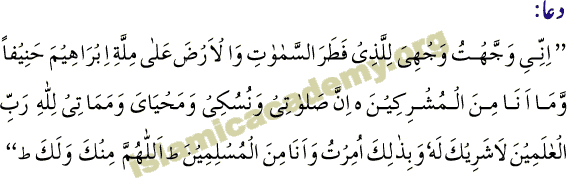 Then slaughter the animal with a sharp knife whilst reading:
 If the Qurbani is for oneself then read the following duaa after the zabh (slaughter):
 If the Qurbani is on another’s behalf then in the above arabic dua replace
  with
with  , then the name of the person
If the animal is shared then read the duaa by writing it down like so:
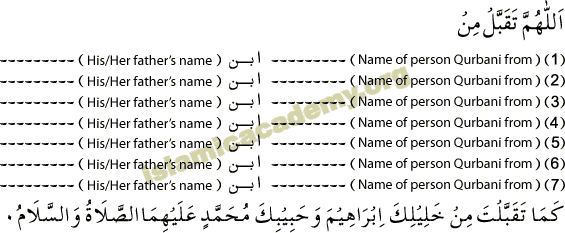
Translated by:
Omair Abdul Jabbar Qaderi, Student of Darul Uloom Azizia
The Fazail and Masail of Qurbani
To zabh (slaughter) a specific animal in the days of Nahr is Qurbani.The Qurbani is the sunnat of Sayeduna Ibrahim (Alaihis Salaam). Muslims were told to do Qurbani, Allah Tabaraka wa Ta’la says:
Therefore offer prayer for your Lord, and do the sacrifice. (Quran 110:2)
Ahadith and Aasar
Hadith 1: Sayeduna Zaid bin Arqam Radi Allahu anhu narrates the Sahabae Kiram asked the Beloved Prophet (Swall Allahu alaihi wasallam), “Ya Rasool Allah, what is Qurabani?”He (Swall Allahu alaihi wasallam) said, “This is the Sunnat of your father Ibraheem (Alahis Salaam).”
Sahaba said, “Ya Rasool Allah, what sawaab will we get in this?”
He (Swallal Allahu alaihi wasallam) said, “A virtue for every hair (on the animal).”
(Ahmad, Ibnu Majah)
Hadith 2: Sayedatuna Aisha (Radi Allahu anhu) narrates that Rasool Allah said, “There is no dearer deed of Ibne Adam in the days of Qurbani than flowing the blood (doing Qurbani) and that animal will come with his horns, hairs, and hooves on the day of Qayamt. Thee blood of the Qurbani reaches the stage of acceptance before it reaches the floor. (Tirmizi, Ibnu Majah)
Hadith 3: Sayeduna Abu Hurairah (Radi Allahu anhu) narrates the Beloved Prophet (Swall Allahu alaihi wasallam) said, “Whoever has the means and does not do Qurbani should not come near our place of Eid. (Ibnu Majah)
Hadith 4: Sayeduna Ibn Abbas (Radi Allahu anhu) narrates that the Beloved Prophet (Swall Allahu alaihi wasallam) said, “The wealth which is spent on Qurbani on the day of Eid, there is no dearer wealth than it. (Tabrani)
Hadith 5: Imam Ahmad (Radi Allahu anhu) narrates that the Beloved Prophet (Swall Allahu alaihi wasallam) said, “The best Qurbani is the one which expensive in price and very fat. (Imam Ahmad)
Hadith 6: Sayeduna Ali (Karam Allahu wajahaul kareem) narrates that the Beloved Prophet (Swall Allahu alaihi wasallam) said, “Four animals are not proper for Qurbani:
1) One eyed whose one eyedness is evident
2) Ill whose illness is visible
3) Crippled whose crippled ness is visible
4) Thin whose bones don’t have marrow
(Imam Ahmad, Tirmizi, Abu Dawood, Nasaee, Ibnu Majah, Darmi)
Hadith 7: Sayeduna Ali (Karam Allahu wajahaul kareem) narrates that, “Rasool Allahu (Swall Allahu alaihi wasallam) stopped us from Qurbani of [an animal whose] ears are cut and horns are broken. (Imam Ahmad, Ibnu Majah)
Hadith 8: Sayeduna Abdullah Ibn Masood (Radi Allahu anhu) narrates that the Beloved Prophet (Swall Allahu alaihi wasallam) said, “In Qurbani, a cow is from seven and a camel is from seven.” (Tabrani)
Hadith 9: Sayeduna Ibn Abbas (Radi Allahu anhu) narrates that the Beloved Prophet (Swall Allahu alaihi wasallam) said, “Rasool Allah (Swall Allahu alaihi wasallam) stopped us from Qurbani in the night.”
Hadith 10: Sayedatuna Ume Salma (Radi Allahu anha) narrates that the Beloved Prophet (Swall Allahu alaihi wasallam) said, “When you see the moon of Zul Hijjah and any one of you wants to do Qurbani, he should stop from shaving or cutting his hair and trimming his nails. (Muslim)
Hadith 11: Sayeduna Abdullah Ibn Umar (Radi Allahu anhu) narrates that the Beloved Prophet (Swall Allahu alaihi wasallam) said, “I have been ordered for the Yaumul Adha (The Day of Adha), Allah has made this day an Eid for the ummat.
A man asked, “Ya Rasool Allah, tell me if I have no animal besides a maneeha, so can I do Qurbani with it?
He said, “No, but cut your hair, nails, and mustache and shave the hair below the navel, in this your Qurbani will be fulfilled near Allah.” (Abu Dawood, Nisaee)
That is, whoever does not have the means to do Qurbani will get the reward for Qurbani by doing these things.
Some Important Masail
Masala 1: With regard to Qurbani, sahibul Nisaab is the person whoA) Owns 52 ½ taula of silver (612.4 grams, 19.75 ounces) or 7 ½ taula of gold
(87.48 grams, 2.82 ounces)
B) Or owns the equivalent of the price of these in business possessions or non-business possessions
C) Or owns equivalent of naqd [cash] or money
And the owned possessions are more than the hajate asalia [explaned in Masala 2].
Masala 2: Hajate asalia, that is, the things which are necessary to for a livelihood. Possessions of these things does not make Qurbani nor Zakat wajib. Like the house to live in, the clothes to wear in the summer and winter, possessions the household, animals or cars for transportation, equipment for work, and books for the people of knowledge.
Masala 3: By books it is meant the Quran, Hadith, Usool of Hadith, Usool of Fiqh, Ilm Kalaam, Akhlaq, and other religious books. Just like this, books of medicine are hajate asalia for a doctor.
Masala 4: Besides this, more than copy of books such as religious books, Nahw, Sarf, Nujoom, Stories, Deewan, and other books are not hajate asalia. If their value reaches nisab then Qurbani is wajib.
Masala 5: Quran Majeed is not hajate asalia for a Hafiz.
Masala 6: Qurbani is not wajib on a musafir (traveler) even if he is wealthy. Although, if he wishes to do Qurbani for Nafl reward then he may do so.
Masala 7: If a woman has jewelry given to her by her father or any other possessions which she owns which reaches the value of nisab then Qurbani is wajib on her also. This is the order of every year.
Masala 8: If a Malikun Nisaab (owner of Nisaab) does Qurbani in his name at one time and if he is a malikun nisaab the next year then it is wajib on him to do Qurbani [for that year]. This is the order of every year. (Tirmizi)
Masala 9: If malikun nisaab person does Qurbani in someone else’s name besides himself and not in his name then he is a grave sinner. So, if one wants to Qurbani for someone else then he should make arrangements for another Qurbani for the other person.
Animals of Qurbani
Masala 10: Male or female camel, cow, buffalo, goat, sheep, and ram are all permissible.Masala 11: A camel must of 5 years, a cow and buffalo of 2 years, a goat, sheep, and ram of 1 year. If the animal is younger than this then qurbani is not permissible, if older than this then it is permissible, in fact it is better. However, if the six-month old offspring of sheep or ram is so big that from looking from afar the sheep or ram looks like a year old then it is permissible.
Masala 12: It is wajib for a sahibun nisaab to slaughter one goat or to slaughter a seventh of camel, cow, and buffalo, it is not permissible to slaughter less than one seventh of the animal.
Masala 13: To slaughter more than a seventh is permissible such as five or six persons slaughtering a cow or buffalo, rather, one person may do qurbani of a whole cow.
The Days of Qurbani
Masala 14: The time for Qurbani is from the dusk of dawn on the 10th of Zul Hijjah to the sunset of the 12th of Zul Hijjah, that is, two days and three nights.Masala 15: The best date for Qurbani is the 10th of Zul Hijjah, then 11th, and then the 12th.
Masala 16: It is not Jaiz (permissible) to do Qurbani before the Salah of Eid in the city.
The Ahkam of Meat and Skin
Masala 17: One may eat the meat of Qurbani himself or give it to a poor or wealthy person or feed them, rather, it is mustahab (better) that the one who has done the Qurbani also eats some from the Qurabni.Masala 18: It is best for the one who will do Qurbani that to not eat or drink anything from dusk of dawn on the 10th of Zul Hijjah and when the Qurbani is done, he eat from it’s meat.
Masala 19: It is better to divide the meat into three parts in such a way that one for the Fuqaraa and Masakeen (the poor and needy), one part for the friends and relatives, and one part for his own household. If the household persons are many then he my feed all of the meat to his household.
Masala 20: If one did Qurbani on behalf of a deceased person then he may eat the meat himself and feed it to his friends and relatives, that is, if the deceased had not made waseeah (willed) this Qurbani otherwise give all in Sadqa.
Masala 21: If the Qurbani is done because of a mannat (vow) then one can not eat the meat himself nor can he feed to the wealthy rather it is wajib to give it in Sadqa, the vower my be a wealthy or poor person.
Masala 22: It is not permissible to give the meat to a Kafir.
Masala 23: It is not permissible to give the leather or meat or any part of it to the butcher or to the one who did the slaughter (for you) as a payment.
Leather of Qurbani
Masala 24: It is not permissible to sell the leather/skin of the Qurbani and bring the money into personal use. However, one may use the leather/skin for personal use.Masala 25: Many people give the skin to religious Madarsas which is a afdal(best) and the means of getting great reward. At times, it is difficult to send the skin to the madarsas so people sell the skin and send the money to the madarsas which is also no problem.
The Way of Zabh (Slaughter)
Masala 26: Four arteries are to be cut whilst slaughtering. If three of the four arteries are cut or most of the each four arteries are cut then the slaughterd is Halal.Masala 27: If one purposely did not say Arabic text (that is, did not take the name of Allah) then the animal is haraam. If he forgot then the animal is halal
Masala 28: If one handed over the animal to the butcher before completely slaughtering the animal then the butcher must also say Arabic text before proceeding with slaughtering the animal.
Masala 29: To slaughter in such a way that the knife reaches the haraam magz (spinal cord ) or that the head comes off is makrooh (undesirable) but the animal can be eaten, that is, the undesirability is with this action not with the zabeeha (slaughter).
Masala 30: The same order applies for a woman as does for a man, that is, the slaughter of a woman (performed by a woman) is permissible.
Masala 31: The slaughter of a Mushrik or Murtad (performed by them) is dead and haraam.
The Way of Qurbani
Place the animal of Qurbani on the left side in such a way that its’ face is towards the Qibla and put the left leg on its side. And say this duaa before slaughtering: with , then the name of the personIf the animal is shared then read the duaa by writing it down like so:
INDIAN RAILWAY TELEPHONE ISLAM FOR ALL WORLD MUSLIM SHAADI MUSLIM NAMES

Eid al-Adha

·
عيد الأضحى
·
Eid al-Adha
·
"Feast of the
Sacrifice"
|
|
|
Blessings for Eid Al-Adha.
|
|
Observed by
|
|
Type
|
|
Significance
|
·
Commemoration
of Ibrahim (Abraham)'s
willingness to sacrifice his young first-born and only son in obedience of a
command from God
|
Celebrations
|
·
Eid salat
·
Gatherings of
family and friends
Meals, especially lunches and late breakfasts (brunches)
·
Wearing clean
clothes
·
Giving money/gifts
to kids as a token of love
·
Helping the poor by
giving foods, money, meat and clothes in the name of zakath
|
Observances
|
Dhabihah, sacrifice of a sheep, cow, goat,
buffalo or camel
Donating one-third of the sacrifice meat to friends and neighbors
Donating one-third or more of the sacrifice meat to the poor and needy
|
Begins
|
|
Ends
|
13 Dhu al-Hijjah
|
Date
|
10 Dhu al-Hijjah
|
11 September (Umm al-Qura)[2]
|
|
2017 date
|
1 September[2]
|
2018 date
|
21 August[2]
|
Related to
|
·
Hajj
·
Umrah
|

Eid
al-Adha (Arabic: عيد الأضحى ʿīd
al-aḍḥā, [ʕiːd ælˈʔɑdˤħæː],
"Festival of the Sacrifice"), also called the "Sacrifice
Feast" or "Bakr-Eid", is the second of two Muslim holidays celebrated
worldwide each year, and considered the holier of the two. It honors the
willingness of Ibrahim (Abraham) to sacrifice his
son, as an act of submission to God's command,
before God then intervened, through his angel Jibra'il (Gabriel) and informs him
that his sacrifice has already been accepted. The meat from the sacrificed
animal is preferred to be divided into three parts. The family retains one
third of the share; another third is given to relatives, friends and neighbors;
and the remaining third is given to the poor and needy.
In
the Islamic lunar calendar, Eid al-Adha falls on the
10th day of Dhu al-Hijjah and lasts for
three days.[3] In the
international(Gregorian)
calendar, the dates vary from year to year drifting approximately 11
days earlier each year.
Eid
al-Adha is the latter of the two Eid holidays, the former being Eid al-Fitr. The
word "Eid" appears once in Al-Ma'ida, the fifth
sura of the Quran, with the meaning "solemn festival".[4]
Like
Eid al-Fitr, Eid al-Adha begins with a sunnah prayer of two rakats followed
by a sermon (khutbah). Eid
al-Adha celebrations start after the descent of the Hujjaj,
the pilgrims performing the Hajj, from Mount Arafat , a hill east of Mecca. Eid sacrifice may take place until
sunset on the 13th day of Dhu al-Hijjah.[5] The days of Eid
have been singled out in the Hadith as "days of
remembrance" and considered the holiest days in the Islamic Calendar.
The takbir (days) of Tashriq are from the Fajr prayer of the 9th of
Dhu al-Hijjah up to the Asr prayer of the 13th of
Dhu al-Hijjah (five days and four nights). This equals 23 prayers: five on the
9th–12th, which equals 20, and three on the 13th.[6]
Other names
The
Arabic term "festival of the sacrifice", ʿīd al-aḍḥā / ʿīd ul-aḍḥā is borrowed into Indo-Aryan
languages such
as Urdu, Hindi, Bengali, Gujarati, and Austronesian languages such as Malay andIndonesian (the last often
spelling it as Aidil
Adha or Idul Adha).
Another Arabic word for "sacrifice" is Qurbani (Arabic: قربان.) The Semitic root Q-R-B (Hebrew ק-ר-ב) means "to be close to someone/something"; other
words from the root include qarov, "close",
and qerovim, "relatives." The senses of root meaning
"to offer" suggest that the act of offering brings one closer to the
receiver of the offering (here, God). The same stem is found in Hebrew and for
example in the Akkadian language noun aqribtu "act
of offering."
Eid
al-Kabir, an Arabic term meaning "the Greater
Eid" (the "Lesser Eid" being Eid al-Fitr),[7] is used in
Yemen, Syria, and North Africa (Morocco, Algeria, Tunisia, Libya, and Egypt).
The term was borrowed directly into French as Aïd el-Kebir.
Translations of "Big Eid" or "Greater Eid" are used in
Pashto (لوی اختر Loy
Axtar), Kashmiri (Baed Eid),
Urdu and Hindi (Baṛī Īd), Tamil (Peru Nāl,
"Great Day") and Malayalam (Bali
Perunnal, "Great Day of Sacrifice"). Albanian, however,
usesBajram(i) i vogël or
"the Lesser Eid" (as opposed to Bajram
i Madh, the "Greater Eid", for Eid al-Fitr) as
an alternative reference to Eid al-Adha.[citation needed]
The
festival is also called "Bakr-Eid" in Urdu and Hindustani
languages (بقر عید, baqr
`īd),[8][better source needed] stemming from
the Arabic word al-Baqara meaning
"The Cow", although some have wrongly attributed it to the Urdu and
Hindustani word bakrī,
meaning "goat", because of the tradition of sacrificing a goat in
South Asia on this festival. This term is also borrowed into other Indian
languages, such as Tamil Bakr
`Īd Peru Nāl.[citation needed] Some names refer
to the fact that the holiday occurs after the culmination of the annual Hajj. Such names are
used in Malaysian and Indonesian (Hari Raya Haji "Hajj
celebration day",[9][10][11] Lebaran Haji,Lebaran
Kaji), and Tamil (Hajji Peru Nāl).[citation needed]
It's
also known as Id
ul Baqarah in
Egypt, Saudi Arabia and in the Middle East, as Eid è Qurbon in Iran, Kurban Bayrami ("the
Holiday of Sacrifice") in Turkey, Baqarah
Eid in
India, Pakistan and Trinidad, Eid
el-Kebir in
Morocco, Tfaska
Tamoqqart in
the Berber language of Jerba, Iduladha or Qurban in Singapore,
Malaysia, Indonesia and the Philippines, Qurbani
Eid in
Bangladesh, Bakr-Id ("Goat
Eid") in parts of Pakistan and India and Tabaski or Tobaski in Senegal and
West Africa[9][10][11][12] (most probably
borrowed from the Serer language — an ancient Serer religious festival[13][14][15][16][source needs translation]), Babbar Sallah in Hausa language, Pagdiriwang ng
Sakripisyo in Filipino and ciida gawraca in Somali.[citation needed] Eid al-Adha has
had other names outside the Muslim world. The name is often simply translated
into the local language, such as English Feast
of the Sacrifice, German Opferfest,
Dutch Offerfeest, Romanian Sărbătoarea
Sacrificiului, and Hungarian Áldozati ünnep.
In Spanish it is known as Fiesta
del Cordero[17] or Fiesta del
Borrego[18] (both meaning
"festival of the lamb").
Origin
According
to Islamic tradition,
the valley of Mecca (in present-day Saudi Arabia) was a
dry, rocky, and uninhabited place. God instructed Abraham to bring Hagar (Hājar), his Arabian
(Adnan) wife, and Ishmael to the Arabia from the land of Canaan.
As
Abraham was preparing for his return journey back to Canaan, Hagar asked him,
"Did God order you to
leave us here? Or are you leaving us here to die?" Abraham did not even
look back. He just nodded, afraid that he would be too sad and that he would
disobey God. Hagar said, "Then God will not waste us; you can go".
Though Abraham had left a large quantity of food and water with Hagar and
Ishmael, the supplies quickly ran out, and within a few days the two began to
feel the pangs of hunger and dehydration.
Hagar
ran up and down between two hills, al-Safa and Al-Marwah, seven times, in her desperate
quest for water. Exhausted, she finally collapsed beside her baby Ishmael and
prayed to God for deliverance. Miraculously, a spring of water gushed forth
from the earth at the feet of baby Ishmael. Other accounts have the angel Jibra'il,
striking the earth and causing the spring to flow in abundance. With this
secure water supply, known as the Zamzam Well, they
were not only able to provide for their own needs, but were also able to trade
water with passing nomads for food and supplies.
Years
later, Abraham was instructed by God to return from Canaan to build a place of
worship adjacent to Hagar's well (the Zamzam Well). Abraham and Ishmael
constructed a stone and mortar structure – known as the Kaaba – which was to be the gathering
place for all who wished to strengthen their faith in God. As the years passed,
Ishmael was blessed with nubuwwah (prophethood)
and gave the nomads of the desert his message of submission to God. After many
centuries, Mecca became a thriving desert city and a major center for trade,
thanks to its reliable water source, the Zamzam Well.
One
of the main trials of Abraham's life was to face the command of God to
sacrifice his dearest possession, his son. The son is not named in the Quran,
but most modern Muslims believe it to be Ismail. Upon hearing
this command, Abraham prepared to submit to will of God. During
this preparation, Shaitan (the Devil) tempted Abraham
and his family by trying to dissuade them from carrying out God's commandment,
and Abraham drove Satan away by throwing pebbles at him. In commemoration of
their rejection of Satan, stones are thrown at symbolic pillars during the Stoning
of the Devil during
Hajj rites.
When
Abraham attempted to cut his throat, he was astonished to see that his son was
unharmed and instead, he found a dead ram which was slaughtered. Abraham had
passed the test by his willingness to carry out God's command.[19][20]
This
is mentioned in the Quran as follows:
100 "O
my Lord! Grant me a righteous (son)!"
101 So We gave him the good news of a boy ready to suffer and forbear.
102 Then, when (the son) reached (the age of) (serious) work with him, he said: "O my son! I see in vision that I offer thee in sacrifice: Now see what is thy view!" (The son) said: "O my father! Do as thou art commanded: thou will find me, if Allah so wills one practising Patience and Constancy!"
103 So when they had both submitted their wills (to Allah), and he had laid him prostrate on his forehead (for sacrifice),
104 We called out to him "O Abraham!
105 "Thou hast already fulfilled the vision!" – thus indeed do We reward those who do right.
106 For this was obviously a trial–
107 And We ransomed him with a momentous sacrifice:
108 And We left (this blessing) for him among generations (to come) in later times:
109 "Peace and salutation to Abraham!"
110 Thus indeed do We reward those who do right.
111 For he was one of our believing Servants.
112 And We gave him the good news of Isaac – a prophet – one of the Righteous.
101 So We gave him the good news of a boy ready to suffer and forbear.
102 Then, when (the son) reached (the age of) (serious) work with him, he said: "O my son! I see in vision that I offer thee in sacrifice: Now see what is thy view!" (The son) said: "O my father! Do as thou art commanded: thou will find me, if Allah so wills one practising Patience and Constancy!"
103 So when they had both submitted their wills (to Allah), and he had laid him prostrate on his forehead (for sacrifice),
104 We called out to him "O Abraham!
105 "Thou hast already fulfilled the vision!" – thus indeed do We reward those who do right.
106 For this was obviously a trial–
107 And We ransomed him with a momentous sacrifice:
108 And We left (this blessing) for him among generations (to come) in later times:
109 "Peace and salutation to Abraham!"
110 Thus indeed do We reward those who do right.
111 For he was one of our believing Servants.
112 And We gave him the good news of Isaac – a prophet – one of the Righteous.
Abraham
had shown that his love for God superseded all others: that he would lay down
his own life or the lives of those dearest to him in submission to God's
command. Muslims commemorate this ultimate act of sacrifice every year during
Eid al-Adha. While Abraham was prepared to make an ultimate sacrifice, God
ultimately prevents the sacrifice, additionally signifying that one should
never sacrifice a human life, especially not in the name of God.
Eid prayers
Devotees
offer the Eid al-Adha prayers at the mosque.
Who must attend
1. Men should go to mosque—or a Eidgah (a field where
eid prayer held)—to perform eid prayer; Salat al-Eid is Wajib according toHanafi and Shia (Ja'fari) scholars, Sunnah al-Mu'kkadah according to Maliki and Shafi'i jurisprudence.
Women are also highly encouraged to attend, although it is not compulsory.
Menstruating women do not participate in the formal prayer, but should be
present to witness the goodness and the gathering of the Muslims.[23]
2. Residents, which excludes travellers.
3. Those in good health.
When is it
performed]
The
Eid al-Adha prayer is performed any time after the sun completely rises up to
just before the entering of Zuhr time, on the
10th of Dhu al-Hijjah. In the event of a force majeure (e.g. natural
disaster), the prayer may be delayed to the 11th of Dhu al-Hijjah and then to
the 12th of Dhu al-Hijjah.
The Sunnah of
preparation
In
keeping with the sunnah of Muhammad, Muslims
are encouraged to prepare themselves for the occasion of Eid. Below is a list
of things Muslims are recommended to do in preparation for the Eid al-Adha
festival:
2.
Prepare
for personal cleanliness—take care of details of clothing, etc.
3.
Dress
up, putting on new or best clothes available.
Rites of the Eid
prayers
The
scholars differed concerning the ruling on Eid prayers. There
are three scholarly points of view:
3.
That
it is Wajib on all Muslim men
(a duty for each Muslim and is obligatory for men); those who do not do it
without an excuse are considered sinners. This is the view ofAhmad ibn Hanbal,
and was also narrated from Abu Hanifa.
Eid
prayers must be offered in congregation. Participation of women in the prayer
congregation varies from community to community.[24] It consists of
two rakats (units) with
seven takbirs in the first
Raka'ah and five Takbirs in the second Raka'ah. For Sunni Muslims, Salat
al-Eid differs from the five daily canonical prayers in that no adhan (call to prayer)
or iqama (call) is
pronounced for the two Eid prayers.[25][26] The salat (prayer) is then
followed by the khutbah, or sermon, by the Imam.
At
the conclusion of the prayers and sermon, Muslims embrace and exchange greetings
with one other (Eid
Mubarak), give gifts (Eidi) to
children, and visit one another. Many Muslims also take this opportunity to
invite their non-Muslim friends, neighbours, co-workers and classmates to their
Eid festivities to better acquaint them about Islam and Muslim culture.[27]
The Takbir and
other rites
The
Takbir is recited from the dawn of the ninth of Dhu al-Hijjah to the
thirteenth, and consists of:[28]
Allāhu
akbar, Allāhu akbar
|
الله أكبر الله أكبر
|
lā
ilāha illā-Allāh
|
لا إله إلا الله
|
Wallāhu
akbar, Allāhu akbar
|
والله أكبر الله أكبر
|
walillāhi
l-ḥamd
|
ولله الحمد
|
God
is greatest, God is greatest,
There is no god but God
God is greatest, God is greatest
and to God goes all praise.
There is no god but God
God is greatest, God is greatest
and to God goes all praise.
Multiple
variations of this recitation exist across the Muslim world.
Subscribe to:
Comments (Atom)